
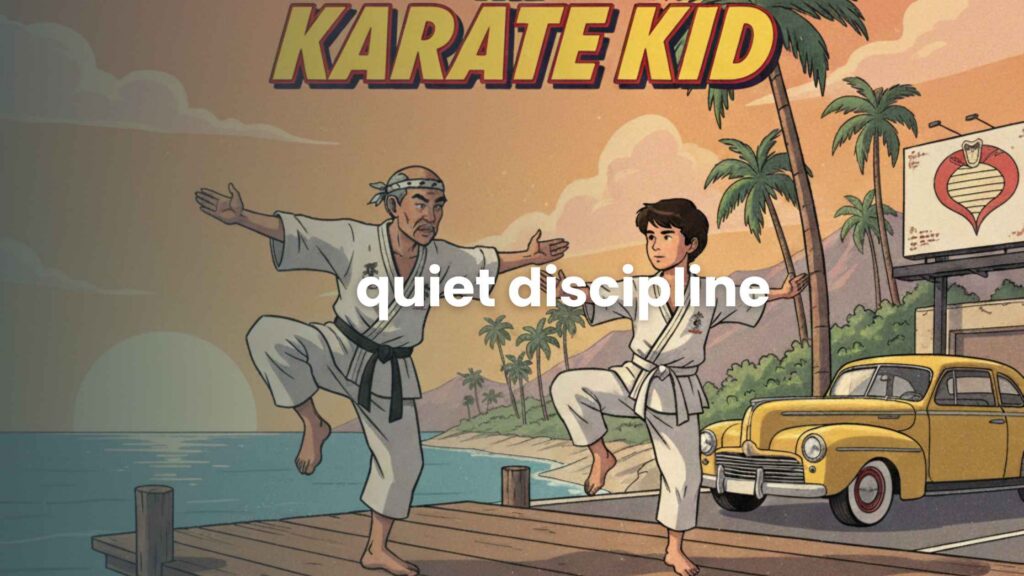
At first glance, The Karate Kid looks like a simple underdog story. Kid gets bullied. Kid meets mysterious mentor. Kid learns to fight. Kid wins.
But anyone who has ever tried to build a skill, change a habit, or stay consistent longer than two weeks knows the real story is not about karate at all.
It is about discipline without immediate reward.
And patience without guarantees.
Or, as the film quietly insists:
You do not train for the moment. You train for the days no one is watching.
The myth of fast progress
Modern culture loves shortcuts. Ten day transformations. Overnight success stories. Productivity hacks that promise everything except effort.
The Karate Kid does the opposite. It opens with boredom.
Daniel does not start with kicks or punches. He paints fences. He sands floors. He waxes cars. Over and over again. To the point where it feels pointless.
This is not cinematic filler. It is the point.
Psychological research on skill acquisition consistently shows that mastery develops through repetition long before understanding appears. Studies on procedural learning demonstrate that the body often learns patterns before the mind can explain them.
In other words, growth is happening even when it feels invisible.
“Wax on, wax off” is behavioral science
The famous training scenes are essentially a lesson in embodied learning.
Daniel repeats movements without knowing why. Only later does he realize those motions have become reflexes. This mirrors what neuroscientists call implicit learning. Skills are stored in neural circuits through repetition, not explanation.
Research in motor learning shows that skills practiced in context and through repetition are retained longer and accessed more reliably under stress.
Which explains why:
The boring work becomes the automatic response when pressure hits.
Discipline is structure, not punishment
Mr. Miyagi’s approach is calm, consistent, and non theatrical. He does not yell. He does not threaten. He does not motivate through fear.
This aligns closely with modern research on self discipline. Studies in psychology show that discipline works best when tied to routine and environment rather than willpower.
Willpower fluctuates. Structure does not.
Miyagi removes choice. Training happens daily. At the same time. In the same way. This reduces decision fatigue and builds habit strength.
Here is a simple comparison:
| Willpower Based Discipline | Structure Based Discipline |
|---|---|
| Requires constant motivation | Runs on routine |
| Emotionally exhausting | Emotionally neutral |
| Prone to inconsistency | Sustainable long term |
The movie teaches this quietly, without lectures.
Patience is not passive
Patience is often misunderstood as waiting. In reality, it is active endurance.
Daniel wants results. He wants validation. He wants to feel progress. What he gets instead is delayed understanding.
Psychological research on delayed gratification, including classic studies like the marshmallow experiments and more recent revisions, shows that patience is less about self control and more about trust in a process.
Daniel does not know the outcome. He trusts the teacher.
Which mirrors real life learning more than any motivational quote ever could.
Why frustration is part of the process
At several points, Daniel nearly quits. This is not weakness. It is predictability.
Studies on learning curves show that frustration peaks before noticeable improvement. This phase is often where people stop. The movie does not skip this part.
Instead, it acknowledges something important:
If you are not frustrated, you are probably not stretching.
Frustration signals engagement at the edge of ability. It is uncomfortable, but necessary.
Discipline versus motivation
Motivation is emotional. Discipline is behavioral.
The Karate Kid never frames discipline as inspiration. There are no speeches about believing in yourself. There is work. Repetitive, unglamorous work.
Research in habit formation supports this approach. Habits form through repeated action, not emotional peaks. Motivation fades. Systems remain.
This is why Daniel improves even on days he does not feel like training.
Progress does not ask for enthusiasm. It asks for attendance.
A small note on humor and humanity
Let us be honest. Painting fences and waxing cars sounds like unpaid labor with a philosophical excuse.
The film knows this. That is why there is humor. Mr. Miyagi is playful. The absurdity is acknowledged.
This matters psychologically. Humor reduces resistance and increases compliance. Studies show that positive emotional context improves learning retention.
Yes, even when learning karate through house chores.
What the film ultimately leaves us with
The Karate Kid endures not because of the final match, but because of everything that came before it.
It reminds us that discipline is quiet. Patience is uncomfortable. Progress is rarely linear. And most growth happens long before applause appears.
You do not need to understand the process to benefit from it.
You just need to show up consistently enough for it to work.
Or, as the film suggests without ever spelling it out:
Mastery begins the moment you stop asking when it will pay off.