
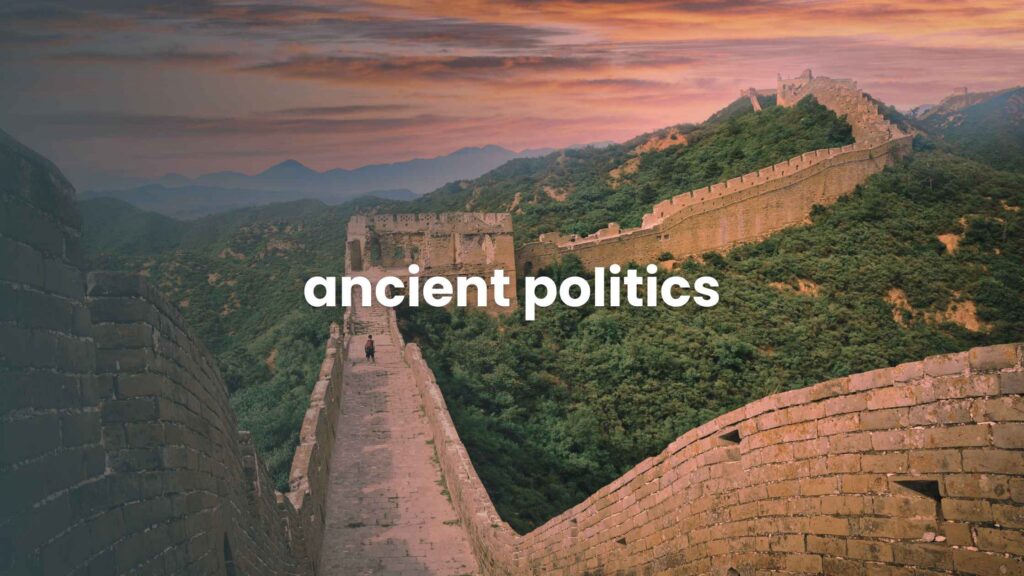
“A wall is more than stone; it’s a statement.”
When most people think of the Great Wall of China, they imagine endless stretches of stone winding over mountains, disappearing into mist, or serving as a tourist backdrop for epic selfies. Yet, behind every brick and rampart lies a story about ancient politics, power, and the lengths rulers would go to control and unify their empires.
“Walls speak louder than words.”
The Great Wall was not a single, continuous structure built overnight. Its construction spanned centuries, starting as early as the 7th century BC, with most of the existing wall credited to the Qin Dynasty under Emperor Qin Shi Huang in the 3rd century BC. Its purpose was as much about politics as defense: to consolidate power, demonstrate authority, and protect territories from nomadic invaders. Scholars note that building the wall was a statement of a ruler’s control over the land and people, signaling that the emperor could mobilize massive labor forces for a common political goal.
“Labor, loyalty, and a little fear.”
Building the wall required immense manpower, often drawn from soldiers, peasants, and prisoners. Estimates suggest hundreds of thousands, possibly over a million people, contributed to its construction. Labor conditions were brutal, and survival often depended on loyalty, obedience, and sheer endurance. The wall thus reflects a political system where authority was absolute, and human lives were tools in the pursuit of empire-wide control.
“Defense is politics in stone.”
The wall wasn’t just a barrier against invasion—it was a visual message to neighboring states and internal rivals. Its scale, visibility, and strategic placement communicated that China was organized, formidable, and capable of enforcing its borders. Ancient Chinese officials understood that politics involved perception as much as actual defense. Even today, historians argue that the Great Wall is as much a monument to centralized governance as it is to military strategy.
“A structure of unification.”
Over time, the Great Wall became a symbol of national unity. Different dynasties repaired, extended, and maintained it, turning it into a shared emblem of Chinese civilization. Beyond defense, it reflected a sophisticated approach to governance: blending military planning, bureaucratic oversight, and monumental architecture to manage a sprawling empire.
“History built brick by brick.”
Looking at the Great Wall today, it’s easy to see it as a tourist attraction or an engineering marvel. But for the people who built it, and for the emperors who ordered its construction, it was a living expression of politics—an enduring reminder that power, fear, and authority can be written not just in laws, but in stone.