
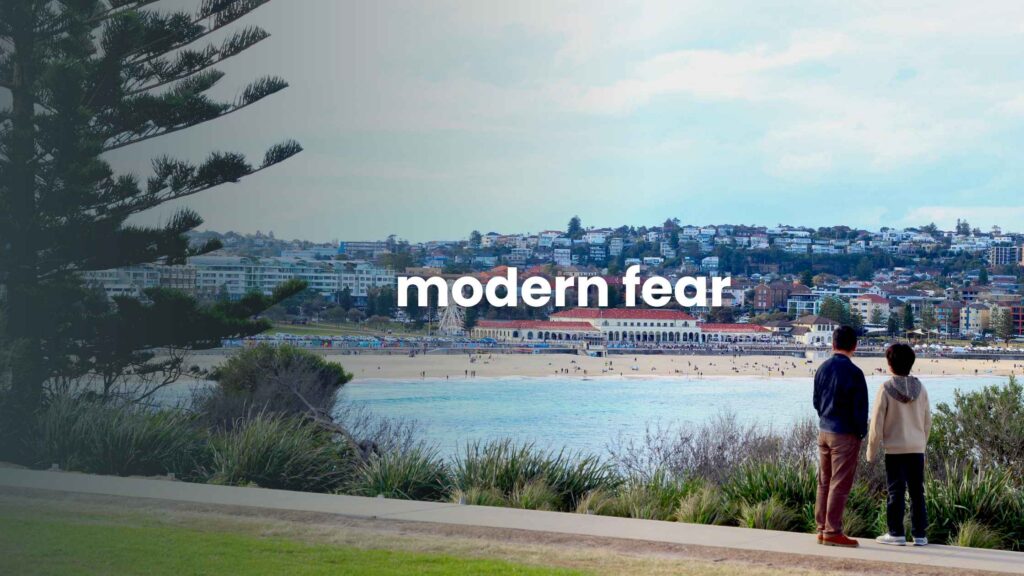
On an ordinary day, in a place associated with sunlight, routine, and safety, fear entered without warning. The Bondi Beach attack was not only a violent act. It was a psychological rupture. A moment where a familiar public space suddenly felt fragile.
What followed was equally revealing. The speed of news. The flood of footage. The immediate collective anxiety. And the quiet question many people asked themselves afterward:
If it can happen there, can it happen anywhere?
This article is not about reliving violence. It is about understanding what events like this expose about modern fear, how it spreads, and why it lingers long after headlines fade.
Fear no longer needs proximity
In the past, fear was often local. A dangerous event affected a neighborhood, a city, or a country. Today, fear travels faster than facts.
Within minutes of the Bondi Beach attack, images and updates circulated globally. People thousands of kilometers away experienced a sense of threat, despite being physically safe.
Research in media psychology shows that repeated exposure to violent news increases perceived personal risk, even when statistical risk remains unchanged. The brain struggles to distinguish between witnessing and experiencing.
In short:
Your nervous system does not care about distance. It reacts to intensity.
Public spaces have become symbolic targets
Modern fear is not only about harm. It is about disruption of normalcy.
Public spaces like beaches, malls, transit hubs, and festivals represent shared safety. They are designed for openness, leisure, and trust. When violence occurs there, it attacks more than individuals. It attacks the idea that everyday life is predictable.
Sociological research suggests that attacks in public, non political spaces produce higher levels of collective fear than targeted or isolated incidents. Why? Because everyone can imagine themselves there.
You may never visit a military base.
You probably will visit a beach, a shop, or a street.
The brain is bad at understanding risk
After events like the Bondi Beach attack, people often overestimate danger. This is not irrational. It is neurological.
The availability heuristic, a well documented cognitive bias, explains this. When examples of something are vivid and recent, the brain assumes they are more common.
Violence shown repeatedly feels frequent, even if it is statistically rare.
Here is a simplified comparison:
| Reality | Perception After High Profile Attacks |
|---|---|
| Violent incidents are rare | Violence feels everywhere |
| Risk varies by context | All public spaces feel unsafe |
| Most days are uneventful | Danger feels constant |
The result is ambient anxiety. Fear without a clear object.
Fear spreads socially, not just individually
Fear is contagious. Not metaphorically. Biologically.
Studies on emotional contagion show that humans subconsciously adopt emotional states from others through tone, posture, and expression. Online environments amplify this effect.
When fear dominates conversation, timelines, and group chats, it becomes normalized. People are not reacting to the original event anymore. They are reacting to each other’s reactions.
This creates a loop:
- Event occurs
- Media intensifies exposure
- Social sharing multiplies emotion
- Fear becomes collective background noise
At that point, fear is no longer a response. It is an atmosphere.
The illusion of total unpredictability
One of the most unsettling aspects of modern violence is the sense that it is random.
Psychologists note that humans cope better with danger when patterns exist. When events feel patternless, anxiety increases.
The Bondi Beach attack reinforced a belief many people already carry:
There is no safe place anymore.
This belief is emotionally understandable, but factually misleading. Safety still exists. Patterns still exist. But fear does not operate on spreadsheets.
It operates on stories.
Why people search for meaning immediately
After violent events, there is an urgent demand for explanations. Motives. Labels. Categories.
This is not curiosity. It is psychological self defense.
Meaning creates distance. If something can be explained, it feels less likely to repeat. Research in trauma psychology shows that uncertainty is often more distressing than known risk.
When explanations remain incomplete, fear stays open ended.
And open ended fear is exhausting.
What modern fear does to daily behavior
You may not notice it immediately, but fear reshapes habits subtly.
People report:
- Increased vigilance in public spaces
- Avoidance of crowded areas
- Heightened sensitivity to noise or movement
- Emotional fatigue from constant alertness
None of these responses are signs of weakness. They are adaptive reactions in an overstimulated environment.
The problem arises when fear becomes permanent rather than situational.
Resilience is quieter than fear
What often goes underreported after attacks is resilience.
People return. Communities regroup. Daily life resumes. This does not mean fear disappears. It means humans recalibrate.
Psychological resilience research emphasizes that recovery is not dramatic. It is routine. It looks like showing up again, despite discomfort.
Or as one might phrase it:
Courage is rarely loud. It is usually repetitive.
What the Bondi Beach attack ultimately reveals
It reveals that modern fear is less about immediate danger and more about perceived instability.
It reveals how deeply connected we are through media, emotion, and imagination.
And it reveals something else, often overlooked: our capacity to feel fear is tied directly to our capacity to care. We are shaken because we still expect safety, still value shared spaces, still believe ordinary days should remain ordinary.
That expectation is not naive. It is human.