
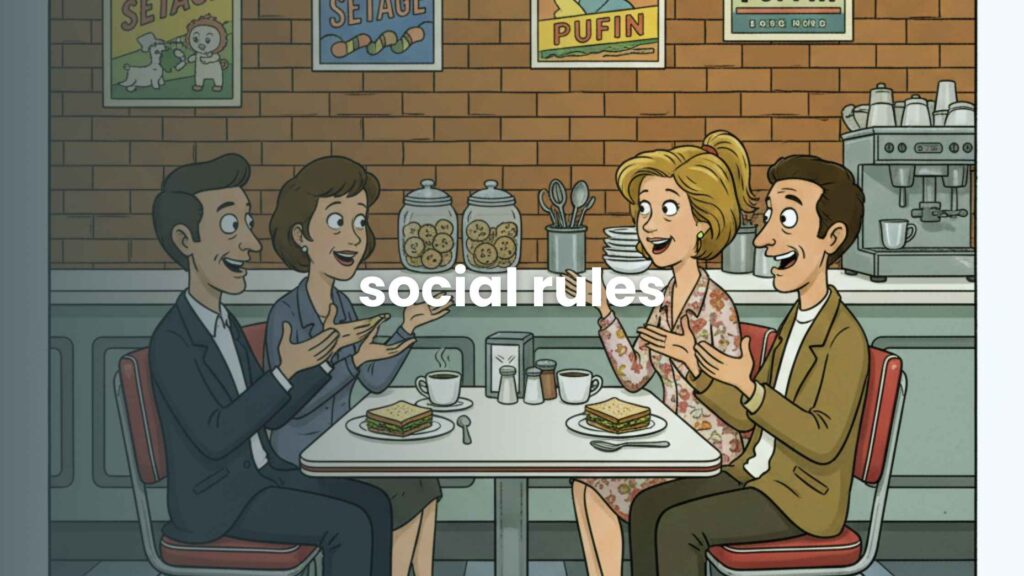
“Everyone knows the rule. No one admits it out loud.”
Seinfeld was famously pitched as a show about nothing. In reality, it was about everything we carefully avoid saying. The show did not invent social rules. It exposed the ones we already live by and politely ignore.
From who pays for dinner to how long you are allowed to stay at a party, Seinfeld turned invisible expectations into punchlines. And somehow, decades later, it still feels uncomfortably accurate.
“Social life runs on unwritten contracts”
Sociologists have long argued that everyday interactions are governed by implicit norms rather than formal rules. Erving Goffman described this as the performance of daily life, where people constantly manage impressions without discussing the script.
Seinfeld simply asked, what happens if we read the script out loud?
Suddenly, a missing thank you note becomes a moral crisis. A double dip turns into an ethical debate. And waiting too long to call someone back becomes a character flaw.
The tyranny of politeness
One recurring theme in Seinfeld is how politeness traps people. Characters agree to things they do not want to do because saying no feels worse than being miserable.
Psychological research backs this up. Studies on social compliance show that people often prioritize avoiding awkwardness over personal comfort, even when it leads to stress or resentment.
In Seinfeld, this results in elaborate lies, fake enthusiasm, and social gymnastics that could have been avoided with one honest sentence.
But honesty, as the show reminds us, is rarely socially rewarded.
“Fairness matters more than we admit”
Who should pay. Who owes whom a favor. Who gets credit for what.
Seinfeld obsessively returned to fairness, especially in trivial situations. That obsession mirrors real life. Behavioral economics shows that humans are deeply sensitive to perceived fairness, even in low stakes interactions.
The show exaggerated these moments, but the emotional reaction was real. When something feels unfair, people get irrational fast.
Jerry and George were not overreacting. They were being human.
Why small rules create big feelings
The show’s genius was understanding that tiny social violations feel personal. Someone talking too close or cutting in line is not just annoying. It feels like a character judgment.
Social psychology calls this norm violation sensitivity. When expectations are broken, the brain interprets it as a potential threat to group order.
Seinfeld took these moments and stretched them until the discomfort became comedy.
We laugh because we recognize the feeling instantly.
“Everyone is watching, even when no one is”
Another uncomfortable truth the show highlighted is how much people care about how they are perceived. Characters constantly worry about reputation, labels, and what others might think.
Research on social self awareness suggests that humans are wired to monitor how they appear to others, even in anonymous or low consequence settings.
Seinfeld made that anxiety visible. The humor came from watching characters spiral over things most people pretend not to care about.
The show was never cynical. Just honest.
Despite its reputation, Seinfeld was not mocking humanity. It was documenting it.
The characters were flawed because social life is flawed. Rules exist because they help groups function, but they also create pressure, confusion, and absurdity.
The show did not offer solutions. It offered recognition.
And recognition is powerful.
Why it still works today
Even in a world of group chats and social media etiquette, the same unwritten rules apply. Who responds first. Who leaves someone on read. Who likes whose post.
The details change. The discomfort does not.
Seinfeld remains relevant because human behavior has not updated its operating system.
Laughing at the rules does not erase them
Watching Seinfeld does not free you from social expectations. But it gives you distance from them.
When you notice yourself overthinking a minor interaction, you might hear a familiar bass line in your head.
And for a moment, you realize you are not alone. Everyone is navigating the same invisible maze.
Some of us are just better at pretending we are not.