
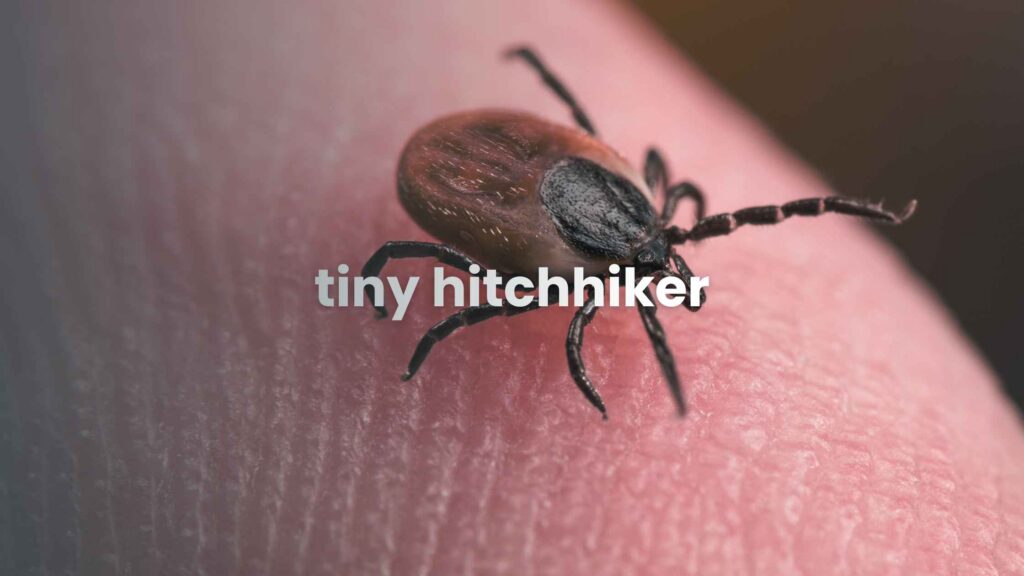
You come home from a walk in the woods.
Shoes muddy. Mind clear. Nature therapy successful.
Then you feel it.
A tiny bump on your leg.
You look down and think,
“That freckle wasn’t there this morning.”
Congratulations. You may have just met one of the most quietly efficient creatures on Earth.
A tick.
Small. Patient. Weirdly strategic.
And slightly terrifying once you learn what is actually happening under your skin.
Let’s slow this down and walk through it, step by step. Because the reality is less dramatic than horror movies suggest, but more fascinating than most people realize.
“First, it does not bite like a mosquito”
Mosquitoes stab and leave.
Ticks commit.
A tick does not simply poke you and sip. It anchors itself.
According to entomology research from the CDC and multiple university vector biology labs, ticks use a specialized mouthpart called a hypostome. Think of it as a tiny barbed straw.
Yes. Barbed.
Which means once it goes in, it is designed to stay in place.
Not exactly the guest you want at your picnic.
They also release a glue like substance from their saliva to secure themselves.
Nature really said: make it extra.
“You usually feel nothing at all”
Here is the creepy part.
Most people never feel the bite.
That is not luck. It is chemistry.
Tick saliva contains mild anesthetics and anti inflammatory compounds. Studies show these substances numb the skin and reduce your immune response.
So while you are happily hiking and discussing life goals, the tick is basically setting up camp unnoticed.
It is the stealth mode of the animal kingdom.
If burglars took notes from ticks, we would all be in trouble.
“Then the slow feeding begins”
Ticks are not in a rush.
They feed slowly, sometimes for hours or even several days.
They insert their mouthparts into small blood vessels and draw blood gradually. During this time, their bodies can expand dramatically.
Some species swell to several times their original size.
Imagine going to dinner and leaving five times heavier. That is tick logic.
Biologically speaking, this slow feeding helps them avoid detection and increases survival.
For us, it just means we really should check our legs more often.
“The real risk is not the bite. It is what comes with it”
Here is where things shift from gross to medically important.
Ticks themselves are not dangerous.
The pathogens they may carry are.
Research from public health agencies like the CDC and European Centre for Disease Prevention and Control shows that certain ticks can transmit:
- Lyme disease bacteria (Borrelia burgdorferi)
- Tick borne encephalitis viruses
- Babesia parasites
- Other regional infections
But here is something many people do not know.
Transmission usually takes time.
For Lyme disease specifically, studies suggest the tick often needs to be attached for 24 to 36 hours or longer before bacteria pass into the bloodstream.
So finding and removing a tick early dramatically lowers risk.
Which means your post hike body check is not paranoia.
It is science.
“Your body reacts like it would to any tiny injury”
If the tick is not carrying disease, your body mostly treats it like a minor wound.
You might notice:
- redness
- slight swelling
- itching
- a small bump
That is just your immune system saying, excuse me, what is this stranger doing here?
Totally normal.
Most bites heal within a few days.
Nothing dramatic. Just mildly annoying. Like a mosquito with better planning skills.
“Removing it matters more than you think”
People get creative here.
Nail polish. Matches. Soap. Panic.
Please do not.
Medical guidelines are very boring and very clear.
Use fine tipped tweezers.
Grab the tick close to the skin.
Pull straight out slowly.
No twisting. No burning. No home science experiments.
Studies show that squeezing or irritating the tick can increase the chance of regurgitation. Yes, that is as unpleasant as it sounds. And it can increase infection risk.
Gentle and steady wins the race.
Basically treat it like removing a sticker, not fighting a dragon.
“Most bites are harmless”
This is important because the internet tends to jump straight to apocalypse mode.
The majority of tick bites do not lead to disease.
Public health data shows that only a percentage of ticks actually carry pathogens, and even then transmission is not guaranteed.
So statistically, odds are in your favor.
Still, awareness is smart.
If you develop symptoms like fever, fatigue, or a spreading rash in the weeks after a bite, doctors recommend checking in with a healthcare professional.
Better safe than dramatic Googling at 2 AM.
“Why ticks exist at all is a different philosophical question”
You might be wondering what role ticks play in the ecosystem besides ruining camping trips.
Ecologists note they are part of food webs. Birds, reptiles, and small mammals eat them. They also help regulate wildlife populations.
So yes, they technically have a purpose.
Still feels personal when one is attached to your knee.
Nature is beautiful. Nature is also occasionally rude.
Both things can be true.
Where this really lands
A tick bite is not a horror story.
It is more like an oddly sophisticated biological interaction.
A tiny creature with numbing saliva, a barbed straw mouth, and the patience of a monk.
Most of the time, nothing serious happens.
But knowing what is going on gives you control.
Check your skin after hikes. Remove ticks properly. Stay informed without spiraling.
Because honestly, the woods are still worth it.
Fresh air beats fear.
Just maybe shower first when you get home.