
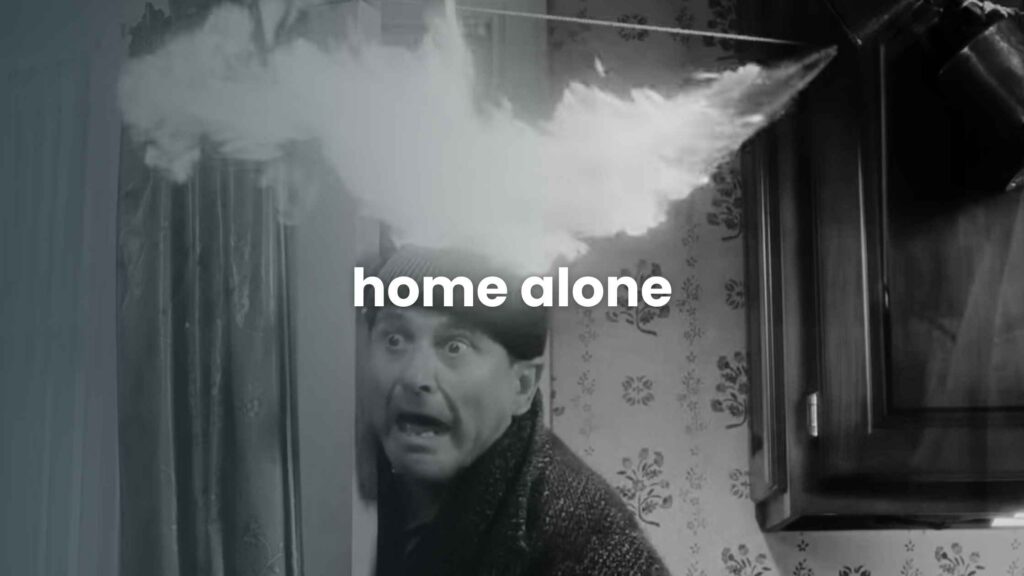
At first glance, Home Alone looks like slapstick chaos wrapped in Christmas lights. Paint cans swinging down staircases. Burglars slipping on ice. A kid screaming into a mirror like it is completely normal behavior.
But underneath the booby traps and the screams, there is a surprisingly serious story about independence, problem solving, and what happens when adults step out of the frame.
“Sometimes independence starts when no one is watching.”
Independence does not arrive politely
Kevin McCallister does not wake up and decide to become independent. It is forced on him. His family leaves. The house is silent. The fridge is full. Fear arrives before confidence.
Psychological research on child development shows that independence often emerges in response to responsibility, not preparation. Children grow faster when they are trusted to handle real situations, even small ones, rather than hypothetical lessons.
Kevin’s first independent acts are basic. Making food. Doing laundry. Going to the store. These are not heroic tasks, but they are foundational. Mastery begins with the ordinary.
“Confidence grows from doing, not from being told you can.”
Problem solving beats perfection
Kevin does not solve problems elegantly. He experiments. He fails. He adjusts. The traps evolve because the first ideas are not perfect.
Studies in developmental psychology emphasize the importance of trial and error in building cognitive flexibility. Children who are allowed to make mistakes without immediate correction develop stronger problem solving skills over time.
Home Alone quietly celebrates this. Kevin is not a genius strategist from the start. He is a kid figuring things out under pressure.
Also, none of this would pass a safety inspection, but that is not the point.
“Independent thinking is messy before it becomes effective.”
Fear is part of growing up, not a sign of weakness
Kevin is scared. Of the basement. Of the old neighbor. Of being truly alone at night. Independence in the movie is not portrayed as fearless. It is portrayed as fearful but functioning.
Research on emotional development shows that children who learn to act despite fear develop greater emotional resilience later in life. Courage is not the absence of fear. It is movement with fear present.
Kevin does not eliminate fear. He learns to coexist with it.
“Bravery is often just fear with a task to focus on.”
Adults do not disappear, they loosen control
An overlooked theme in Home Alone is that independence does not mean abandonment forever. Kevin’s mother spends the entire movie trying to get back. The safety net exists, even if it is temporarily out of reach.
This mirrors findings in attachment theory. Children become more independent when they feel secure, not when they feel disposable. Kevin’s confidence grows because deep down, he knows he is loved.
The movie suggests a healthy balance. Step back enough for growth, but stay emotionally present.
“Independence grows best with a safety net underneath.”
Independence includes moral responsibility
Kevin does not just protect the house. He learns empathy. He befriends the old neighbor. He understands loneliness from the inside.
Research on moral development shows that autonomy and empathy often develop together. When children take responsibility for themselves, they become more aware of others.
Kevin’s independence is not only practical. It becomes emotional.
“Growing up is not just doing things alone, it is understanding others better.”
Why this still matters today
Modern childhood is often over scheduled and over supervised. Well intentioned adults solve problems before children encounter them. Home Alone presents an uncomfortable question. What happens when kids are allowed to figure things out?
The answer is not that they become reckless superheroes. The answer is that they become capable in small, meaningful ways.
No one is suggesting leaving children home alone for a week. But allowing room for responsibility, mistakes, and self trust matters more than ever.
“Capability is built, not downloaded.”
What kids really learn from Kevin McCallister
They learn that independence is not a personality trait. It is a skill. One developed through experience, patience, and occasional panic.
They learn that adults matter, but so does self reliance. That fear does not disqualify you from acting. And that doing your own laundry is a bigger milestone than it looks.
Also, they learn to distrust burglars named Harry and Marv. Which is probably fine.