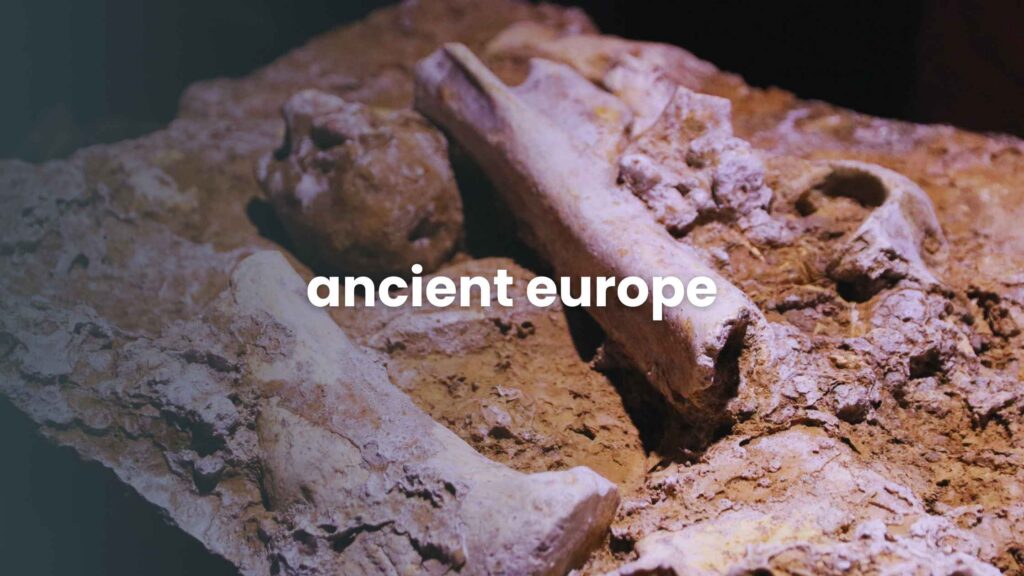
“The past speaks quietly, but it tells incredible stories.”
Europe today is a continent of bustling cities, diverse cultures, and modern wonders. But thousands of years ago, it was home to the first humans trying to survive ice ages, roaming forests, and navigating rivers. The most compelling evidence of their lives comes from ancient bones, and what researchers have discovered is reshaping our understanding of history.
These skeletal remains are not just bones—they are time capsules, holding clues about who these people were, how they lived, and how they adapted to a changing world.
Evidence of Migration
“They didn’t just appear—they moved.”
Ancient DNA analysis from skeletal remains shows that the first Europeans were not a single group. Studies published in Nature reveal that multiple waves of hunter-gatherers and early farmers migrated from Africa, the Middle East, and Central Asia over tens of thousands of years.
These migrations suggest that Europe was a crossroads, with populations mixing, moving, and adapting to different climates. Ancient bones show genetic markers that trace movement patterns long before written records existed.
Insights Into Diet and Health
“What they ate left marks, literally.”
Teeth and bones reveal surprising information about diet. Isotopic studies of early European skeletons indicate that many hunter-gatherers relied heavily on meat and fish, while early farmers consumed more grains and legumes.
Interestingly, dental wear patterns and signs of cavities show the shift from foraging to farming had both benefits and drawbacks. Skeletal analysis also indicates early humans suffered from arthritis, fractures, and nutritional deficiencies, offering a window into the challenges of everyday survival.
Clues About Appearance
“Faces we may have unknowingly passed on the street.”
Ancient DNA and skull measurements allow scientists to reconstruct what early Europeans looked like. Some populations had darker skin and blue eyes, while others had lighter skin adapted to northern latitudes. Cranial shapes and bone structure also hint at height, body build, and even muscle strength.
Research in anthropology demonstrates that these physical traits were responses to climate, diet, and lifestyle—proof that adaptation is written in our bones.
Cultural Practices
“Bones tell more than biology—they tell stories.”
Archaeologists have found bones showing signs of ritual, injury treatment, and even symbolic behavior. Burials with ornaments, tools, or painted shells suggest that early humans had social and spiritual complexity far earlier than previously thought.
Analysis of trauma patterns in bones also indicates early forms of community care. Injured individuals survived longer than expected, hinting that others provided support—an early sign of social cohesion.
Lessons From DNA
“Every genome is a history book.”
The study of ancient DNA has rewritten Europe’s early history. It reveals that modern Europeans are descendants of at least three distinct ancestral populations: Western hunter-gatherers, early Near Eastern farmers, and later migrations from the Eurasian steppe.
This genetic mixing explains the diversity seen in Europe today and highlights the complex story of human adaptation over millennia.
What We Learn From Bones
“History isn’t just in books—it’s in our bodies.”
Bones are silent witnesses, yet they speak volumes about migration, survival, culture, and adaptation. They remind us that the first Europeans were inventive, resilient, and social beings facing harsh environments. By studying them, we gain perspective not only on history but also on the human capacity to endure, innovate, and thrive.
Next time you see a skeleton in a museum, remember: it’s more than bones. It’s a story of survival, movement, and humanity.
What Ancient Bones Reveal About the First People in Europe