
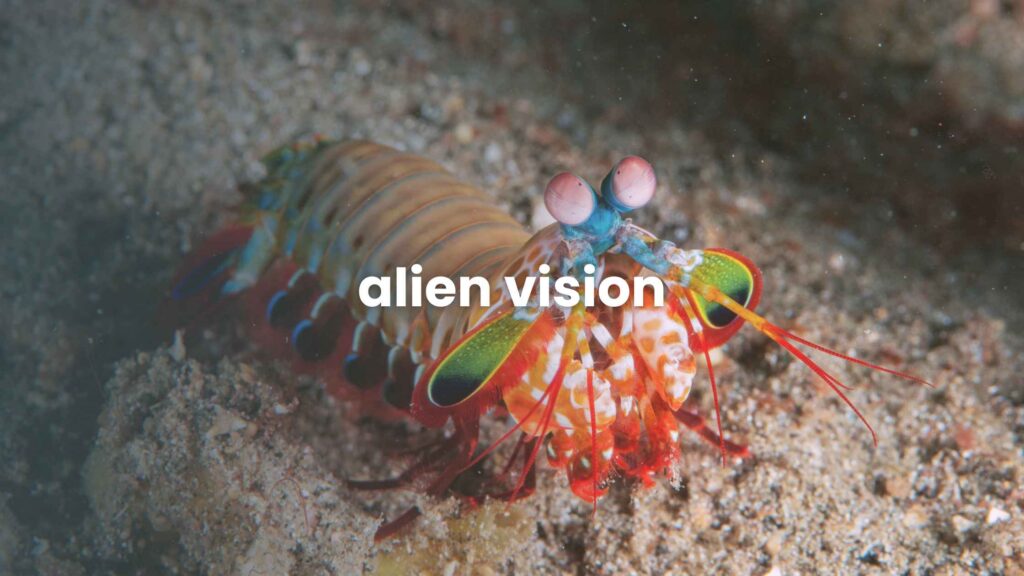
For a creature that looks like it escaped from a sci-fi storyboard, the mantis shrimp lives a surprisingly ordinary life. It hides in coral crevices, hunts for food, and minds its own business. And yet, this small marine animal quietly breaks several rules we once thought applied to all vision, strength, and perception.
If nature had a sense of humor, the mantis shrimp would be one of its best jokes.
“It sees more colors than we ever will”
The mantis shrimp is famous for its eyes. While humans have three types of color receptors, mantis shrimp have up to twelve. For years, this led to headlines claiming they see a rainbow far beyond human imagination.
The truth is more interesting.
Instead of processing colors by comparing signals like humans do, mantis shrimp use a rapid recognition system. Each receptor is tuned to a narrow wavelength, allowing the shrimp to identify colors almost instantly, without much brain processing. Think less artist, more barcode scanner.
Researchers studying marine vision suggest this tradeoff favors speed over detail. In the chaotic environment of coral reefs, reacting fast can matter more than seeing subtle shades of teal.
So yes, they see colors we cannot. But they do it in a way that feels almost alien compared to our own perception.
“Those eyes are doing way more than you think”
Color is only part of the story.
Mantis shrimp can detect polarized light, something humans cannot perceive at all. Polarized light helps them spot transparent prey, navigate complex underwater environments, and possibly communicate with other mantis shrimp using signals invisible to predators.
Some scientists believe this ability functions like a private visual language. Imagine texting in a format only your closest friends could read, while everyone else sees nothing but static.
Not bad for an animal smaller than your hand.
“Vision is impressive, but the punch rewrites physics”
If the mantis shrimp were only about eyesight, it would already be impressive. But then there is the punch.
Certain species can strike with a speed comparable to a bullet. The force is so extreme that it creates cavitation bubbles, tiny pockets of vapor that collapse with enough energy to stun or kill prey even if the shrimp misses.
For a brief moment, the water around the punch reaches temperatures close to the surface of the sun. All of this happens faster than the human eye can register.
Aquarium owners learned this lesson the hard way. Mantis shrimp have been known to crack glass tanks. The shrimp did not mean to start a physics demonstration. It was just hungry.
“A nervous system built for efficiency, not excess”
What makes the mantis shrimp especially fascinating is that it does not rely on a massive brain to manage all this complexity. Its nervous system is highly specialized, delegating tasks directly to sensory organs rather than routing everything through central processing.
In other words, it is not smarter by human standards. It is more efficient.
Neuroscientists often point to animals like the mantis shrimp as reminders that intelligence and perception do not follow a single evolutionary path. Nature optimizes for survival, not elegance.
“Why this tiny animal matters more than it seems”
The mantis shrimp challenges comfortable assumptions about vision, cognition, and even strength. It shows that seeing more does not always mean understanding more. That speed can outperform depth. And that evolution sometimes favors shortcuts over sophistication.
In a world obsessed with doing everything better, faster, and bigger, the mantis shrimp quietly proves that doing things differently can be just as powerful.
Sometimes the most radical innovations are already swimming beneath the surface.