
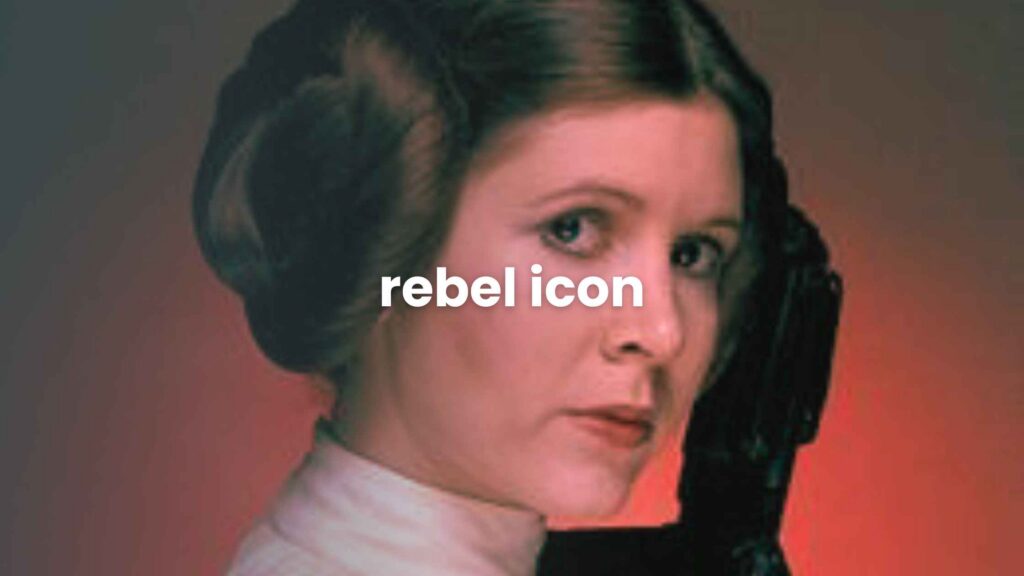
“Some characters are played. Others are lived.”
When people think of Princess Leia, they don’t just remember a costume or a hairstyle.
They remember attitude.
The eye roll. The sarcasm. The fearless stare that says, “I will rescue myself, thanks.”
That energy did not come from special effects or clever writing alone. It came from Carrie Fisher herself.
Behind the blasters and starships, there’s a story filled with studio battles, personal struggles, sharp humor, and a woman who quietly reshaped what a sci-fi hero could look like.
Here’s what most people never realized about how Leia became Leia.
“She wasn’t the obvious choice”
The audition almost didn’t happen
Before Star Wars, Carrie Fisher wasn’t a household name.
She had small acting credits and was known mostly as the daughter of Hollywood royalty, Debbie Reynolds and Eddie Fisher. That connection sometimes worked against her. Casting directors worried audiences might see her as “the famous daughter,” not the character.
George Lucas reportedly tested dozens of young actresses. Leia needed strength, wit, and intelligence, not just looks.
Fisher’s dry humor during auditions stood out. She delivered lines with confidence and bite, almost like she was teasing the script itself.
That edge became Leia’s personality.
Sometimes casting is not about finding a princess. It’s about finding someone who refuses to act like one.
“The buns weren’t random”
That famous hairstyle had a backstory
The iconic side buns look futuristic now, but they were inspired by history.
Costume designers researched revolutionary women from the early twentieth century, particularly Mexican fighters known as soldaderas. Their braided, coiled hairstyles symbolized strength and resilience.
Leia wasn’t meant to look delicate. She was meant to look battle ready.
And yet, Carrie joked for decades that she felt like she was wearing “headphones made of cinnamon rolls.”
Even legends start with slightly uncomfortable hair days.
“She fought to make Leia tougher”
Less damsel, more general
Early drafts of the script reportedly gave Leia more traditional “rescued princess” moments. Fisher pushed back.
She questioned lines that sounded too passive. She preferred snappier dialogue. More sarcasm. More backbone.
Film historians often note how unusual this was for the 1970s. Female sci-fi characters were frequently decorative or secondary. Leia insults her captors, grabs a blaster, and helps plan her own escape.
That shift wasn’t accidental.
Carrie once described Leia as someone who “bosses everyone around and gets away with it.”
And honestly, we love her for that.
“The metal bikini wasn’t her idea”
The costume she famously disliked
Let’s address it.
Return of the Jedi’s gold bikini became one of the most talked-about costumes in movie history.
But Fisher was not thrilled. She later explained that the outfit was uncomfortable and freezing under studio lights. She also worried it reduced Leia to eye candy after two films of leadership and strength.
Over time, though, she reclaimed it with humor. She told young fans that Leia didn’t stay a prisoner. She strangled her captor with the very chain meant to hold her.
In her words, if you’re going to wear something ridiculous, at least win the fight.
Classic Carrie.
“She used humor as armor”
Jokes hiding real struggles
Behind the scenes, Carrie dealt with intense pressure. Fame hit fast. Very fast.
Psychologists who study celebrity culture often describe how sudden global recognition can cause anxiety, isolation, and identity struggles. Fisher spoke openly about her experiences with bipolar disorder and addiction later in life.
But on set, she cracked jokes constantly.
Crew members recalled her turning tense moments into laughter with sharp one-liners. Humor became her survival tool.
Leia’s wit was not acting. It was Carrie’s natural defense system.
When Leia fires off sarcastic remarks at Darth Vader, that’s not just writing. That’s Carrie saying, “You don’t scare me.”
“She rewrote the idea of a sci-fi heroine”
Strength without losing softness
Leia didn’t fight like a stereotypical action hero.
She led. Negotiated. Strategized. Commanded respect.
Researchers studying gender representation in media often cite Leia as one of the earliest mainstream examples of a female character who combined authority with empathy. She wasn’t trying to be “one of the guys.” She was simply competent.
And competence is powerful.
Little girls didn’t just want to be rescued anymore.
They wanted a blaster.
“She never stopped being Leia”
Even off screen
Years after Star Wars, Fisher continued to embrace the role.
Some actors run from their most famous characters. She leaned in. She met fans, signed autographs, told brutally honest stories at conventions, and laughed about everything, including herself.
She understood something important.
Leia wasn’t just fiction. For many people, she was courage during childhood, comfort during tough times, and proof that smart women could lead galaxies.
That’s not a role you abandon. That’s a legacy.
More Than a Princess
Carrie Fisher didn’t simply play Princess Leia. She shaped her. Sharpened her. Humanized her.
Without Fisher’s wit, stubbornness, and honesty, Leia might have been just another space royalty in a fancy dress.
Instead, she became one of the most beloved characters in film history.
Not because she looked royal.
Because she acted fearless.
And because behind the costume stood a woman who refused to be anything less than real.