
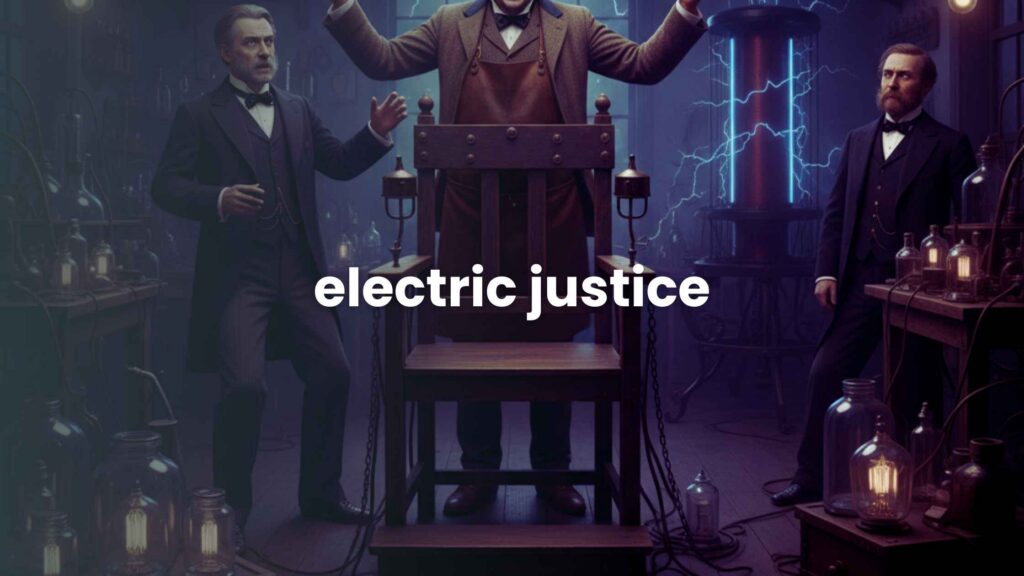
“It was meant to be more humane.”
That is the uncomfortable truth.
The electric chair was not created out of cruelty, at least not in intention. It was born from a late nineteenth century belief that science could make even death more civilized.
Whether that belief was accurate is another story.
To understand why the electric chair exists at all, we have to step into a time when public executions were still common, technology was rapidly evolving, and society was wrestling with the idea of what counted as humane punishment.
It was a strange mix of progress and darkness.
“Executions were already controversial”
By the mid 1800s, hanging was the primary method of execution in the United States and parts of Europe. But hanging often went wrong.
Historical records describe botched executions that resulted in prolonged suffering. Medical professionals and reformers began questioning whether there might be a quicker, less visibly violent method.
At the same time, electricity was transforming cities. Streetlights flickered on. Power systems expanded. It felt futuristic.
Some reformers believed electricity could offer a faster and supposedly painless death.
The thinking was clinical. If electricity could power a city, perhaps it could end a life instantly.
That assumption would soon be tested.
“The war of the currents”
The electric chair was invented during a fierce competition between two electrical systems.
On one side was Thomas Edison, who promoted direct current. On the other was George Westinghouse, who backed alternating current. Their rivalry is often called the War of the Currents.
Historians note that Edison sought to portray alternating current as dangerous in order to undermine his competitor. Public demonstrations were staged showing animals being electrocuted with alternating current to highlight its risks.
This atmosphere helped shape the narrative that electricity, particularly alternating current, was powerful enough to kill quickly.
In 1888, New York established a commission to find a more humane execution method. After reviewing options, they chose electrocution.
Not because it had been proven safe or painless.
But because it seemed modern.
“The first execution shocked the nation”
The first person executed by electric chair was William Kemmler in 1890 at Auburn Prison in New York.
Officials believed the process would be swift.
It was not.
Eyewitness reports describe a malfunction during the initial attempt, requiring a second application of current. Journalists at the time documented the disturbing scene, and public reaction was mixed at best.
Medical experts later debated whether electrocution truly delivered instant unconsciousness. Some research suggested the experience could be more complex and traumatic than originally assumed.
The idea of a clean scientific solution quickly became morally complicated.
“Science does not always mean humane”
The late nineteenth century was a period of enormous faith in technology. Industrialization had improved transportation, communication, and manufacturing.
Many reformers believed science could solve social problems, including capital punishment.
Yet the electric chair revealed a deeper tension.
Technological advancement does not automatically equal ethical progress.
Studies in criminology and legal history show that debates over execution methods often reflect broader societal anxieties about suffering, justice, and morality.
The electric chair was not simply a machine.
It became a symbol of how society defines humanity.
“Why it spread”
Despite early controversy, electrocution became widely adopted in several states during the twentieth century. Officials viewed it as more controlled than hanging and less public.
Executions moved behind prison walls. Out of sight.
That shift mattered.
Sociologists argue that when practices become less visible, public discomfort often decreases. Distance can make difficult realities easier to tolerate.
Over time, other methods such as lethal injection were introduced, again framed as more humane alternatives.
History shows a pattern.
Each new method is presented as progress.
Each eventually faces scrutiny.
“A complicated legacy”
Today, the electric chair is rarely used. Some states still allow it as an option, but lethal injection has largely replaced it.
Legal scholars continue to debate whether any method of execution can truly be considered humane.
Research into pain perception and neurological response raises ongoing ethical questions about certainty and suffering.
The electric chair remains a reminder of a period when technological optimism collided with moral complexity.
It was designed with the intention of reducing cruelty.
Yet its history demonstrates how unpredictable outcomes can be when science and punishment intersect.
When Progress Meets Power
The electric chair was not invented out of a desire to create something brutal.
It was introduced as an improvement.
A modernization.
A solution.
But history rarely moves in straight lines. What seems advanced in one era can look deeply flawed in another.
The electric chair stands as proof that innovation without ethical clarity can create more questions than answers.
It forces us to consider something larger than electricity or punishment.
It asks whether efficiency should ever be confused with compassion.
And that question still matters.