
“Some movies age. Others become fossils in the best way possible.”
There are films you enjoy once, and then there are films that live rent free in your brain forever.
Jurassic Park is definitely the second type.
Even decades later, people still remember the first T. rex roar, the water rippling in the glass, and that collective childhood realization that maybe dinosaurs coming back was both the coolest and worst idea ever.
But here’s the fun part. Behind the scenes, the making of Jurassic Park was almost as wild as the island itself.
Budget hacks, happy accidents, scientific debates, and last-minute decisions shaped what many consider one of the greatest blockbusters ever made.
Let’s open the gates.
Careful though. Life finds a way.
The dinosaurs were supposed to be mostly stop motion
“Technology changed everything at the last second”
Originally, the dinosaurs were planned using traditional stop motion animation. Artists would move small physical models frame by frame, the way classic monster movies were made.
It would have worked. It just wouldn’t have looked revolutionary.
Then a small effects team tested early computer-generated animation. Just a simple walking T. rex skeleton.
When director Steven Spielberg saw the test, everything changed. According to crew interviews, it was a genuine “oh wow” moment. They realized digital dinosaurs could look alive, not animated.
So halfway through production, the team pivoted heavily to CGI.
Film historians often point to this decision as a turning point in cinema. Jurassic Park didn’t just tell a story. It quietly launched the modern era of visual effects.
Not bad for a last-minute gamble.
The T. rex roar isn’t a dinosaur at all
“It’s basically a very angry zoo”
That legendary roar sounds prehistoric and terrifying.
But dinosaurs obviously didn’t leave audio recordings, so sound designers had to get creative.
The final roar is actually a layered mix of animals. Baby elephants, tigers, and even alligators were combined and manipulated to create something huge and unfamiliar.
Sound experts often explain that blending known animal noises makes fictional creatures feel more believable to the brain.
So technically, the king of dinosaurs is part elephant.
Which somehow makes it even better.
The shaking water glass was ridiculously simple
“Low tech beats high tech sometimes”
One of the most iconic shots in movie history is just a cup of water on a dashboard.
Boom. Boom. Boom.
Ripples.
Instant fear.
You might assume it was some complicated special effect.
Nope.
They literally placed a guitar string under the cup and plucked it to create vibrations.
That’s it.
Sometimes cinema magic is less “advanced technology” and more “someone with a string and a good idea.”
Honestly, that makes the scene even cooler.
The actors were actually terrified during the storm scene
“That wasn’t all acting”
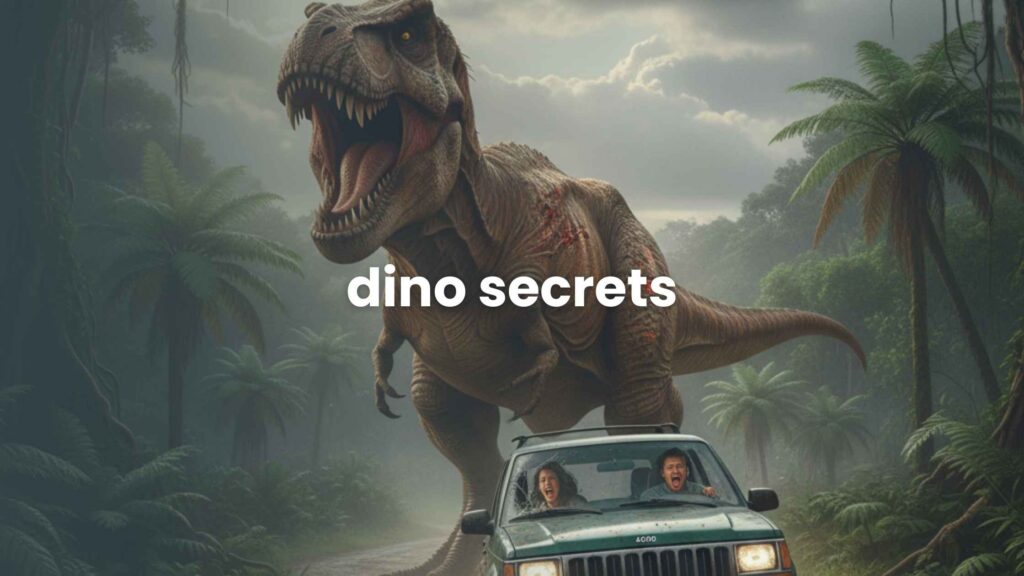
During the T. rex attack, rain pours down and the dinosaur thrashes the car around like it’s a toy.
Here’s the catch.
The animatronic T. rex kept malfunctioning.
Because of the water, the giant robotic dinosaur occasionally moved unpredictably between takes. Crew members have said it would suddenly jerk or shift without warning.
Which meant when the actors looked scared, they often genuinely were.
Imagine sitting in a fake car while a multi-ton robot dinosaur glitches toward you.
That’s not acting. That’s survival instinct.
Raptors were smarter than originally written
“The villains got an upgrade”
Early drafts of the script treated the velociraptors more like standard predators.
But as paleontologists and consultants shared new research, the team adjusted their behavior to feel more intelligent and coordinated.
The kitchen scene, where the raptors quietly stalk the kids, was built around the idea that these creatures could strategize and problem-solve.
That choice made them infinitely scarier.
A big monster is frightening.
A smart monster is nightmare material.
Science made the movie better. And slightly ruined our sleep.
Jeff Goldblum’s chaotic energy was partly improvised
“Life finds a way, and so does Jeff”
Dr. Ian Malcolm’s witty, unpredictable personality wasn’t entirely scripted.
Jeff Goldblum added many of his own pauses, quirks, and line deliveries. That awkward charm and half-philosophical rambling? Very much him.
Film researchers often note that small improvisations can make characters feel authentic instead of robotic.
Goldblum basically Goldblumed the role into something iconic.
There is truly no other word for it.
The film’s science wasn’t pure fantasy
“Dinosaurs, but grounded”
While cloning dinosaurs from amber-preserved mosquitoes sounds wild, it wasn’t completely random science fiction.
The concept was inspired by real genetic research discussions happening at the time about preserved DNA and de-extinction possibilities.
Of course, experts agree the movie stretches reality quite a bit.
Still, anchoring the story in semi-plible science made everything feel just believable enough to be terrifying.
Because if something feels possible, it hits harder.
Way harder.
What makes Jurassic Park special isn’t just the dinosaurs. It’s the creativity behind the curtain. Simple tricks, risky tech choices, scientific input, and a bit of happy chaos all came together to create something timeless.
It reminds you that great movies aren’t built by perfection. They’re built by experimentation, accidents, and people saying, “let’s try this and see what happens.”
And sometimes, that’s how legends are born.
Preferably without the dinosaurs escaping