
“Some cities feed you twice. Once on the street, once at the table.”
There are places in the world where food is not just nourishment, but a social language. In these cities, a paper plate eaten standing up can be just as meaningful as a tasting menu served on white linen. Street food and fine dining do not compete here. They coexist, inform each other, and sometimes even blur into one delicious identity.
What makes a city truly special is not just Michelin stars or viral food stalls. It is the way food moves between classes, neighborhoods, and moods, without losing its soul.
“Street food is memory, fine dining is interpretation”
Street food is often the most honest form of cooking. It is shaped by necessity, tradition, and speed. Researchers in food anthropology have long noted that street food preserves cultural memory more directly than formal cuisine, because recipes are passed hand to hand rather than plate to plate (FAO, 2016).
Fine dining, on the other hand, is reflection. Chefs reinterpret those same flavors using technique, narrative, and sometimes very small portions. In cities that do both well, fine dining does not erase street food. It studies it.
Bangkok: chaos on the sidewalk, precision on the plate
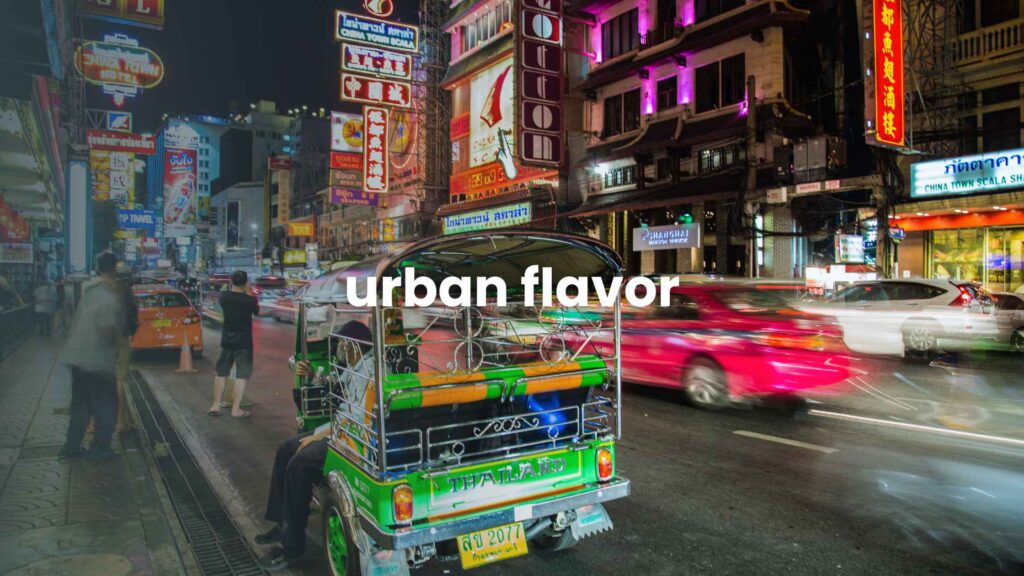
Bangkok is perhaps the most famous example of this balance. On one street corner, you will find a cook flipping pad thai over a roaring flame. A few blocks away, chefs serve multi course menus inspired by those exact flavors.
Food researchers from Chulalongkorn University have pointed out that Bangkok’s culinary strength lies in its density. Ingredients, skills, and traditions circulate rapidly between informal and formal kitchens. Street vendors influence fine dining trends, not the other way around.
Also worth noting: some of the city’s most celebrated meals are still eaten on plastic stools. Status is optional.
Mexico City: where tradition refuses to be polished away
Mexico City’s food culture proves that refinement does not require distance from the street. Tacos al pastor, tamales, and quesadillas form the backbone of daily eating. At the same time, modern Mexican chefs are earning global recognition by elevating indigenous ingredients rather than replacing them.
Academic studies on Mexican gastronomy highlight that successful fine dining here often keeps one foot firmly in street culture (Pilcher, 2017). The result is food that feels proud, not pretentious.
In Mexico City, a chef who ignores the taco does so at their own risk.
Tokyo: obsession at every level
Tokyo might be the only city where a ramen shop with six seats and a Michelin starred restaurant share the same intensity. Street food in Japan is less chaotic, but no less serious. Precision, repetition, and respect for ingredients define both ends of the spectrum.
Culinary sociologists often reference Japan when discussing mastery culture. Whether grilling skewers at a yatai or crafting a seasonal kaiseki menu, the philosophy is similar: do one thing exceptionally well (Ashkenazi and Jacob, 2000).
The difference is not quality. It is context.
Istanbul: where history eats with you
In Istanbul, food is layered like the city itself. Simit sellers, kebab stands, and fish sandwiches along the Bosphorus coexist with refined restaurants serving Ottoman inspired menus.
Historians studying Ottoman food culture note that court cuisine and street food historically influenced each other, sharing spices, techniques, and ingredients (Albala, 2011). That legacy remains visible today.
Here, eating well does not require choosing sides.
“The best food cities do not ask you to choose”
Cities that truly do it all understand something simple: food culture thrives when it remains accessible. Street food keeps cuisine grounded. Fine dining keeps it curious.
When both are respected, a city becomes more than a destination. It becomes a conversation between past and present, hunger and art, convenience and care.
And the best part? You can participate in that conversation wearing sneakers or a suit. The food does not mind.