
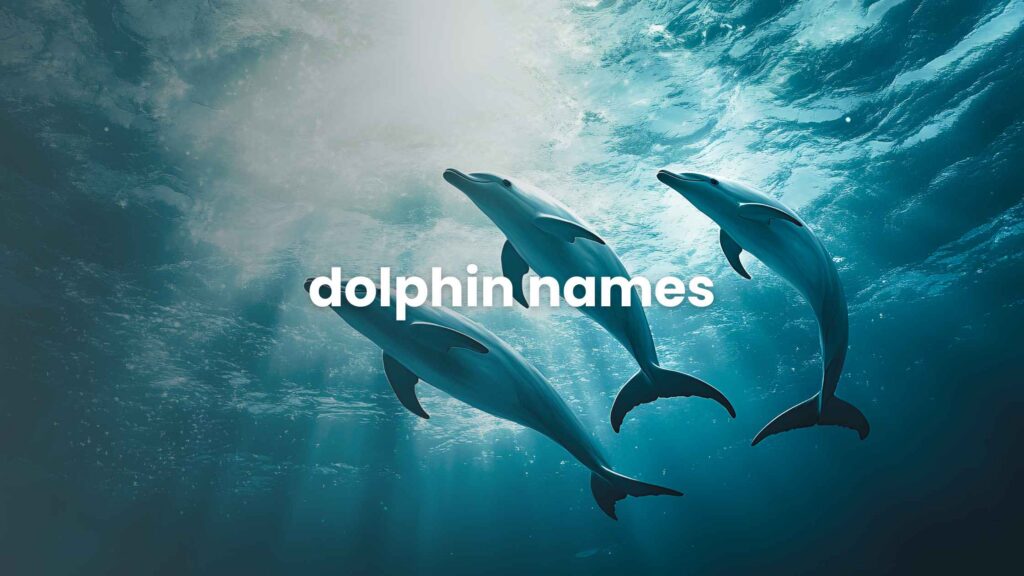
If you think humans are the only species clever enough to name each other, think again. Bottlenose dolphins, long admired for their intelligence, have developed a communication system that resembles human naming. Scientists now have compelling evidence that these marine mammals assign unique “names” to recognize and call each other in the wild.
“Every dolphin has its own signature”
Researchers have discovered that each dolphin produces a distinctive whistle, sometimes called a “signature whistle,” which functions much like a personal name. Unlike generic calls, these signature whistles are consistent over years and even across different social groups. They allow dolphins to identify individuals, maintain contact, and coordinate in complex social networks.
A pivotal study from the University of St Andrews in Scotland observed wild dolphins in Shark Bay, Australia, and found that these whistles were used intentionally. Dolphins responded to recordings of their own signature whistle, even when the source was hidden. This demonstrates not only recognition but the deliberate use of individualized communication.
“It’s like a first name at a crowded pool party”
The way dolphins use signature whistles is fascinating. Young dolphins develop their unique whistle in early life, which is influenced by—but not identical to—the sounds of their mothers. It’s a blend of personal identity and social learning. When researchers play back these sounds, dolphins respond almost as if someone had called their name across a noisy room.
These whistles are more than identifiers. They facilitate complex social behaviors, such as forming alliances, coordinating hunting, and even helping to calm stressed group members. Observations suggest that dolphins can call absent friends, indicating a level of social awareness that goes beyond mere survival.
“Not just noise, but meaningful conversation”
This discovery is reshaping how scientists think about animal communication. It highlights the cognitive sophistication of dolphins, showing that they are capable of abstraction—the ability to associate a sound with an individual, independent of context. According to research published in the journal Science Advances, dolphins use these signature whistles in both playful interactions and serious situations, much like humans modulate tone depending on mood or context.
“Communication with memory attached”
Signature whistles persist for decades. Even if a dolphin moves between social groups, its “name” remains recognizable. This indicates a remarkable memory system and a stable social identity, essential for maintaining long-term relationships in fluid, open-water environments. Unlike some species that rely purely on visual cues or scent, dolphins have evolved a sophisticated acoustic language.
“The ocean is a crowded social network”
For dolphins, life is not solitary. Pods are social hubs, and signature whistles are the threads that keep the network functioning. Scientists believe that the ability to address specific individuals by “name” enhances cooperation, improves coordination during hunts, and strengthens social bonds. This system may even explain why dolphins display empathy and altruism toward injured or separated pod members.
Understanding dolphin communication offers broader insights into the evolution of language and social intelligence. By studying non-human species, researchers hope to uncover the origins of naming, social memory, and the nuanced ways brains can store and recall complex social information.
Dolphins remind us that intelligence is not limited to primates, that names are not a human invention, and that beneath the waves, a sophisticated society thrives, full of conversations we are only beginning to decode.