
“History is written by the victors, but often misremembered by everyone else.”
History has a reputation for being dusty, boring, and overly factual. But in reality, the stories we tell ourselves about the past are often riddled with misconceptions. From famous figures to iconic events, the version most people know is usually a simplified—or sometimes completely wrong—version of what really happened.
Here are some history myths that stubbornly linger in popular belief, along with the surprising truths behind them.
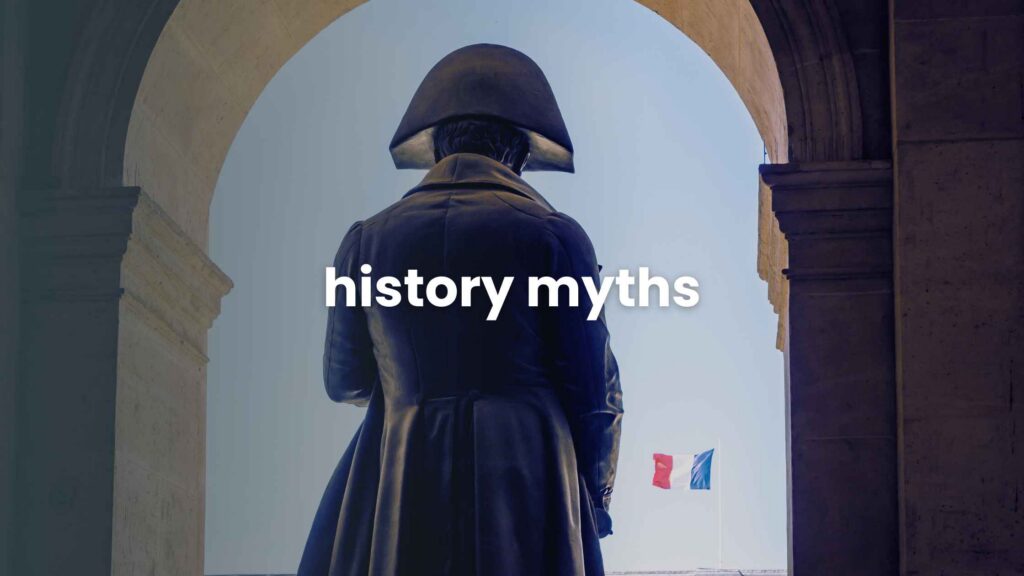
“Napoleon Was Not Short”
We’ve all seen the jokes. The short French general standing on the battlefield, tiny and furious. But historical records reveal that Napoleon Bonaparte was actually around 5’6” to 5’7”, roughly the average height for Frenchmen in his time.
So why the myth? Misunderstandings in measurement systems and British propaganda painted him as smaller than life—a clever way to poke fun at an enemy.
“Vikings Didn’t Wear Horned Helmets”
When imagining Vikings, most of us picture fierce warriors with horned helmets charging into battle. The truth is that there is no archaeological evidence supporting this image. Horned helmets were likely theatrical creations used in 19th-century operas to make Vikings appear more menacing or dramatic.
Vikings did wear helmets, but they were practical, rounded, and horn-free. Apparently, the horns were purely for Instagram aesthetics—centuries early.
“Columbus Didn’t Discover America”
Christopher Columbus is often credited with discovering America in 1492. However, Indigenous peoples had lived there for thousands of years. Moreover, Norse explorer Leif Erikson had reached parts of North America around the year 1000.
Columbus’ voyages were significant for connecting Europe to the Americas, but the notion that he “discovered” a completely unknown land is historically inaccurate.
“The Great Wall of China Is Not Visible from Space”
Legend has it that astronauts can see the Great Wall of China with the naked eye from the moon. Reality check: even astronauts agree this is false. The Wall blends into the natural landscape, making it nearly invisible without aid.
It is, however, an extraordinary human achievement spanning thousands of miles. But claiming you can spot it from orbit is more fantasy than fact.
“Medieval People Didn’t Think the Earth Was Flat”
Contrary to popular belief, educated people in the Middle Ages largely knew the Earth was round. The flat Earth myth is largely a 19th-century invention, designed to make earlier centuries appear ignorant and primitive.
In reality, scholars had already calculated the Earth’s circumference centuries earlier, and global navigation relied on a spherical model.
“Salem Witches Were Not All Women”
Popular culture often portrays the Salem witch trials as targeting women exclusively. While the majority of accused were women, men were also accused and executed. The hysteria stemmed from a mix of superstition, personal grudges, and social tensions, not gender alone.
The stories of Salem remind us that fear and rumor can override logic in terrifying ways.
“Marie Antoinette Didn’t Say ‘Let Them Eat Cake’”
That famous quote attributed to the Queen of France is likely false. Historical evidence shows it was circulating in France long before her reign. It became attached to her reputation as a symbol of aristocratic excess, even though she probably never uttered the words.
Yet the phrase survives, proving that sometimes history favors a good story over the truth.
“History Is Full of Grey Areas”
These myths show that history is rarely black and white. Simplifications, propaganda, and storytelling have shaped what most people learn, often leaving out the nuance, context, and voices of those who were actually there.
Understanding history means questioning the stories we’ve been told and appreciating the complexities behind the events and figures we think we know.
Rewriting the Past With Perspective
By examining these misconceptions, we not only learn what really happened but also how storytelling, culture, and even politics can shape our perception of truth. History is alive, messy, and full of surprises—if you are willing to look beyond the myths.