
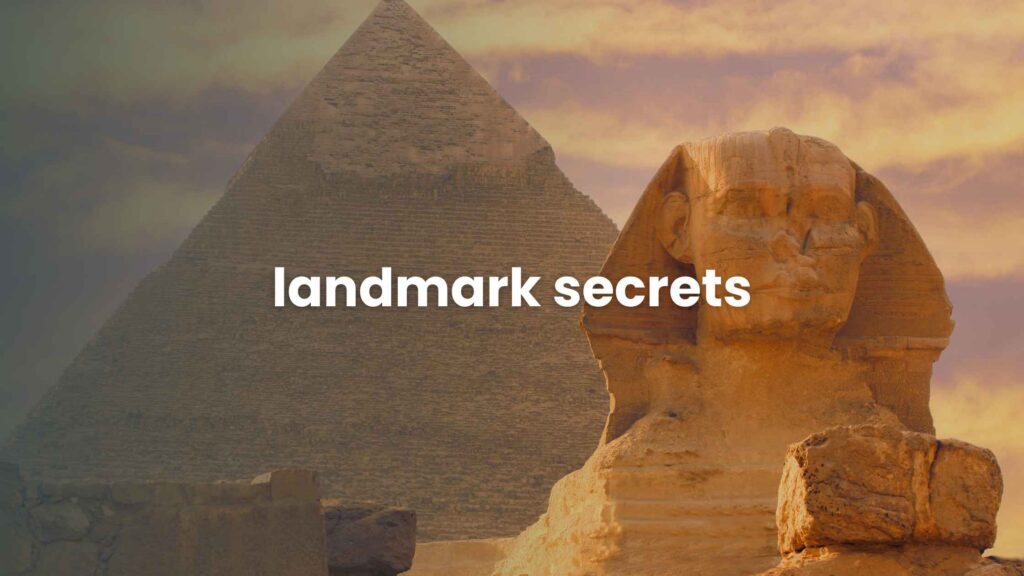
“History is full of secrets, and sometimes they come with a view.”
Famous landmarks are more than just Instagram backdrops. They are time capsules, architectural marvels, and sometimes, unbelievably strange places you never expected. While millions of tourists visit every year, few know the odd stories behind the stone, steel, and sand.
Here are some bizarre facts about famous landmarks that will make you rethink everything you thought you knew.
The Great Pyramid of Giza Has a Golf Course Next Door
“Golf balls near pharaohs. It’s a thing.”
Most people picture the pyramids surrounded by sand and camels. In reality, the Pyramids Golf Course sits surprisingly close to the ancient wonder. Built in the 1990s, it’s one of the few places where you can tee off while looking at a 4,500-year-old pyramid.
The juxtaposition of ancient burial tombs and modern leisure is jarring, but it exists. This is Egypt: where history and tourism collide in unexpected ways.
The Leaning Tower of Pisa Was Not Always Leaning
“Gravity won, architects lost.”
The famous tilt of the Leaning Tower of Pisa was not intentional. Construction began in 1173, and the soft ground beneath one side caused it to tilt slowly during building. Engineers even tried to fix it over centuries, but today, the lean is stable and celebrated.
Modern surveys show that the tower has shifted a mere few inches since restoration work began, proving that even mistakes can become global icons.
Eiffel Tower’s Secret Apartment
“Yes, Gustave had neighbors with a view.”
Gustave Eiffel, the engineer behind the tower, built a tiny apartment at the top, complete with furniture and a telescope. He used it to entertain special guests and experiment with meteorology and radio transmissions. Tourists will never see it—except for a few replicas—but it’s still up there, floating above Paris.
The Colosseum’s Underground Had a Secret Elevator System
“Ancient elevators? Not a modern invention.”
Rome’s Colosseum featured a complex underground system called the hypogeum, used to lift animals and gladiators to the arena floor. Pulley systems and trapdoors allowed wild beasts to appear suddenly, much to the delight (and terror) of spectators.
The engineering was so advanced that it rivals some amusement park rides today, proving Romans were masters of showmanship.
Machu Picchu Was Likely a Royal Estate
“Lost city, VIP edition.”
While tourists think of Machu Picchu as a mysterious citadel, researchers suggest it was more like a luxury estate for Inca nobility, complete with terraced gardens and panoramic views. It wasn’t primarily a fortress or military outpost—it was a private retreat for elites who enjoyed the Andes in style.
Statue of Liberty’s Full Name Is a Mouthful
“Even freedom has a formal title.”
Many call it the Statue of Liberty. Officially, it is Liberty Enlightening the World. The sculpture was a gift from France, designed by Frédéric Auguste Bartholdi, and it took a complex fundraising effort to assemble both the statue and its pedestal in New York Harbor.
A small detail: the statue’s face was inspired by Bartholdi’s mother. So every selfie is technically a tribute to her.
Sydney Opera House Sails Were Inspired by Orange Slices
“Fruit-inspired architecture? Believe it.”
Jørn Utzon, the Danish architect, designed the Opera House roofs as segments of a sphere, inspired by peeling an orange. It’s hard to believe, but those curving sails are literally citrus geometry made concrete. Sometimes, architecture and fruit intuition collide spectacularly.
Stonehenge Was Likely a Healing Site
“Mystery stones with a medical agenda.”
While most think of Stonehenge as a calendar or ceremonial site, archaeologists propose that it may have been a prehistoric healing center, attracting the sick and injured to its giant stones. Some human remains show signs of pilgrimage from distant areas, hinting at early forms of health tourism.
Why These Oddities Matter
“Familiar places are full of surprises.”
Landmarks are often frozen in time in our minds—majestic, immovable, predictable. But history is messy, bizarre, and occasionally whimsical. From golf courses near pyramids to secret apartments in towers, learning these facts reminds us that humans have always found creative, unexpected ways to leave a mark on the world.
Next time you visit, look closer. There’s always more than meets the eye.