
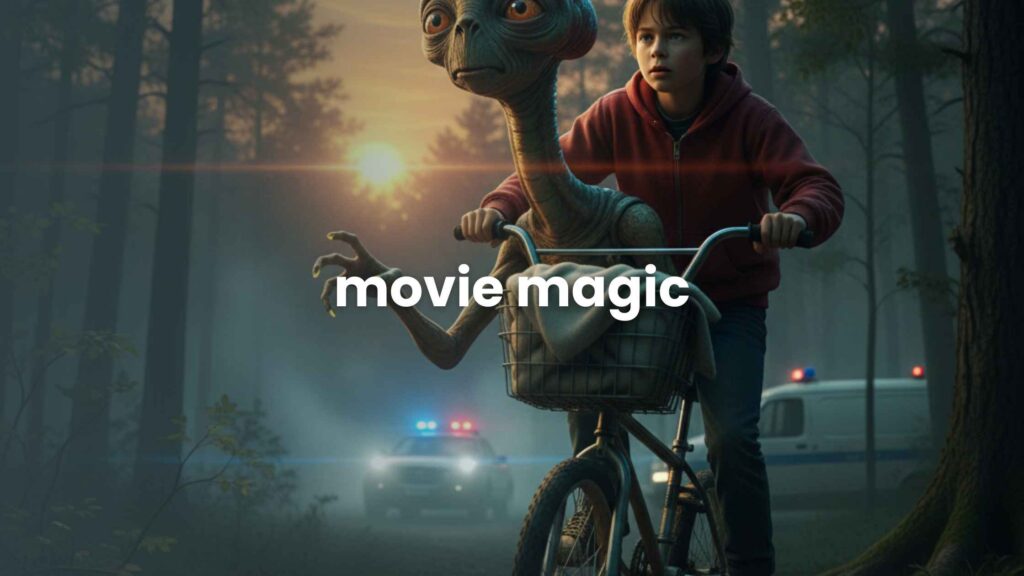
“Some movies don’t just entertain you. They quietly move in and stay forever.”
Almost everyone remembers their first time watching E.T.
Maybe you were a kid hiding behind a blanket during the scary scenes. Maybe you cried when the bike lifted into the sky. Maybe you still get emotional just hearing those first soft piano notes.
It feels magical.
But here’s what makes it even better: the movie wasn’t built with huge technology or flashy tricks. It was built with clever improvisation, happy accidents, and a lot of heart.
And behind the scenes, things were often just as strange and wonderful as the story itself.
Let’s phone home and take a look.
E.T. was mostly a puppet, not CGI
“Before pixels, there were wires and patience”
Today, studios would probably create E.T. entirely with computers.
Back in the early 1980s, that wasn’t really an option.
Instead, the alien was brought to life using animatronics and puppetry. Multiple versions of the model were built. Some for walking, some for close-ups, some just for facial expressions.
At times, several puppeteers operated him at once, controlling eyes, fingers, neck, and even tiny wrinkles in the skin.
Film historians often point out that practical effects feel more “real” to audiences because actors can physically interact with them. That’s part of why E.T. feels alive instead of digital.
You’re not watching an effect. You’re watching something actually there on set.
Also imagine being the poor crew member stuck inside the suit for hours.
Method acting, but sweatier.
The kids weren’t always acting
“Real reactions beat perfect performances”
Director Steven Spielberg made an unusual choice.
Instead of giving the child actors the full script, he let them experience many moments naturally. Sometimes they didn’t know exactly what would happen next.
So their reactions, especially the surprise and fear, were genuine.
In interviews, cast members explained that scenes were sometimes shot almost like a documentary, with Spielberg encouraging improvisation and emotional spontaneity.
Psychology research on performance suggests that authentic reactions are easier for audiences to connect with than polished acting. Your brain subconsciously recognizes what feels real.
Which explains why those kids feel like actual kids, not mini Hollywood robots reciting lines.
The bike scene almost didn’t exist
“One crazy idea changed movie history”
That iconic shot of the bicycle flying across the moon?
It wasn’t always part of the plan.
It came from experimenting with visual effects concepts during production. Once the team realized they could convincingly blend silhouettes with the sky using optical effects, the scene grew into something bigger and more poetic.
It became the emotional symbol of the entire movie.
Funny how one creative risk turned into one of the most recognizable images in cinema history.
Not bad for a “let’s try this” moment.
E.T.’s voice came from unexpected places
“The alien next door”
You might expect a complicated sci-fi voice process.
Instead, the voice was created using a mix of sources. Elderly women, smokers, and various people with raspy tones recorded sounds that were later layered together.
The goal wasn’t “alien.”
It was “fragile and ancient.”
Sound designers often explain that human-like imperfections make characters more relatable. Too synthetic and it feels cold. Too clear and it feels fake.
E.T.’s soft, scratchy voice feels vulnerable.
Which is probably why “I’ll be right here” still hits like an emotional truck.
The movie was filmed mostly in story order
“Growing up together on camera”
Most movies are shot out of sequence. Actors might film the ending before the beginning.
E.T. was different.
Much of the film was shot chronologically so the young actors could naturally build emotional connections over time.
By the final scenes, they genuinely felt attached to the puppet and to each other.
So when they cried during the goodbye scenes?
Yeah. Not entirely acting.
Several crew members later admitted there wasn’t a dry eye on set.
Imagine trying to work a camera while quietly sobbing. Cinema is glamorous.
The government agents were deliberately faceless
“Adults as the unknown threat”
You may notice something interesting when rewatching.
For much of the movie, the adults chasing E.T. are filmed from the waist down or shown without faces.
That wasn’t accidental.
Spielberg wanted the story from a child’s perspective. When you’re a kid, adults can feel distant, mysterious, even intimidating.
So the camera literally reflects that.
Film scholars often reference this technique as visual storytelling through point of view. You see the world the way Elliott sees it.
Which makes the house feel safer and the outside world feel huge and uncertain.
Pretty clever psychology for what looks like a simple family movie.
It was never meant to be a giant blockbuster
“A small story that became huge”
Unlike many modern franchises, E.T. wasn’t designed as a massive commercial machine.
It started as a personal story about loneliness, friendship, and childhood imagination.
Studios didn’t expect it to dominate the box office the way it did.
Yet it became one of the highest-grossing films of its time and influenced family storytelling for decades.
Proof that sometimes the most intimate stories travel the furthest.
Turns out you don’t need explosions to make something unforgettable.
Just a glowing finger and a bike.
What makes E.T. special isn’t special effects or scale. It’s the humanity behind everything. Real kids, practical puppets, small creative risks, and a lot of emotional honesty.
It feels handmade.
And maybe that’s why it still works.
Because beneath the alien and the spaceships, it’s just a story about friendship and not wanting to say goodbye.
Which, honestly, might be the most universal science fiction concept of all.