
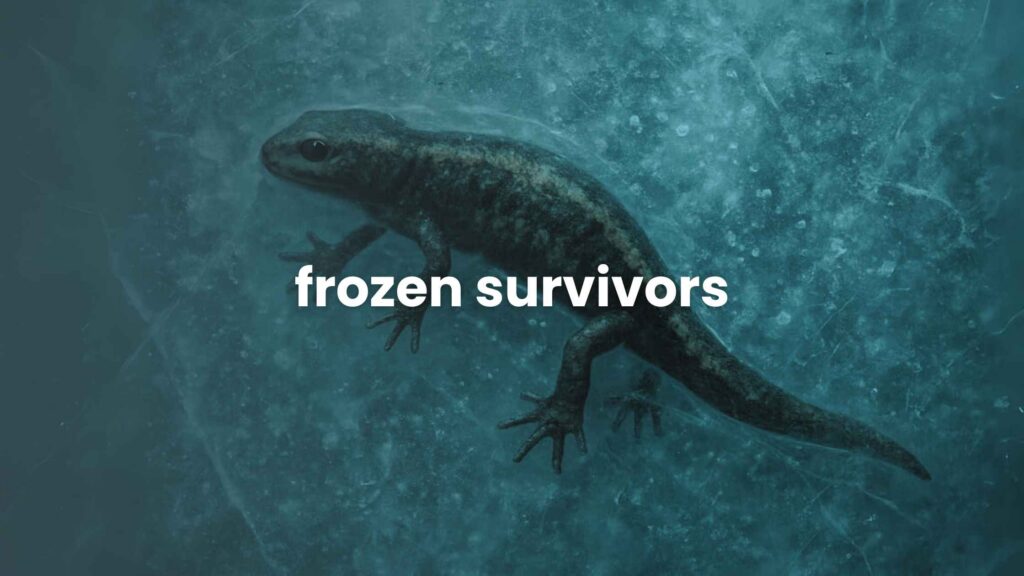
When most creatures face freezing temperatures, their fate seems sealed. Ice crystals tear through cells, organs fail, and life ends in a frosty disaster. Yet, some remarkable animals have evolved strategies that let them survive actual freezing—and come back to life as if nothing happened.
“Frozen, but not forgotten”
Take the wood frog, native to North American forests. During winter, it allows up to 70 percent of its body water to freeze, halting its heartbeat and breathing entirely. By producing natural antifreeze compounds in its tissues, ice forms only in its body cavities, not inside cells. When spring arrives, the frog thaws and resumes life like hitting the ultimate snooze button.
“Tardigrades: tiny masters of survival”
Tardigrades, also known as water bears, are microscopic legends in the survival world. These resilient creatures can endure extreme cold, even dipping below absolute zero in controlled experiments, by entering a state called cryptobiosis. In this suspended animation, their metabolism nearly stops, allowing them to survive not only freezing but also heat, radiation, and vacuum. Scientists joke that tardigrades are basically the superheroes of the animal kingdom.
“Arctic insects: chilling experts”
Certain insects, like the Antarctic midge, survive freezing by replacing water in their bodies with sugar alcohols and proteins that prevent ice from puncturing cells. These insects may spend months encased in ice before thawing to buzz back to life, proving that survival isn’t just about muscles and bones—it’s about chemistry.
“The miraculous wood frog cousin”
The Siberian salamander takes freezing tolerance to another level. Found in Eastern Russia, this amphibian can survive temperatures below -40 degrees Celsius. Its secret lies in storing glucose in its organs to act as an antifreeze, similar to the wood frog but in even harsher climates. When spring arrives, the salamander unfreezes and continues hunting insects, proving resilience is both art and science.
“Brine shrimp: the tiny ice warriors”
Brine shrimp, or “sea monkeys” as some remember them, produce eggs capable of surviving complete desiccation and freezing. These eggs remain dormant for years, sometimes decades, until favorable conditions return. Once thawed and rehydrated, the shrimp hatch and carry on with life as though time had stood still.
These incredible survival strategies challenge our assumptions about life and the limits of biology. They demonstrate that evolution can create solutions that seem more like science fiction than reality. In a world that often seems too fragile, these frozen survivors remind us that life finds a way, even under extreme pressure.